How to Initiate the Philanthropy Conversation [Part Four]
Where should clients give, and can they trust the charity? AI charity search across 86,000+ Canadian charities and WellCheck due diligence in moments.

Jeff Golby
CEO & Co-Founder, WellFunded

Key Takeaways
- Finding the right charity is now a plain-language search across every registered Canadian charity, ranked purely by fit.
- A trusted funder signal adds context without ever changing rankings. Placement can't be bought.
- A WellCheck delivers due diligence in moments: findings, not verdicts, so the family decides.
Where should we give, and can we trust them?
The plan is built. Then your client asks the two questions every advisor dreads: "where should we actually give?" and "is this charity any good?"
These are the questions that used to mean referring out, or worse, guessing. Neither is necessary anymore.
Finding the right charity is now a search
Ask in plain language: "find me the best water charities in Canada." "Youth mental health organizations in Alberta." "Small charities doing refugee resettlement work." The search runs across every registered Canadian charity, more than 86,000 of them, and returns the ones that actually match, ranked by fit with what you asked. Nothing else decides the order. Placement can't be bought.
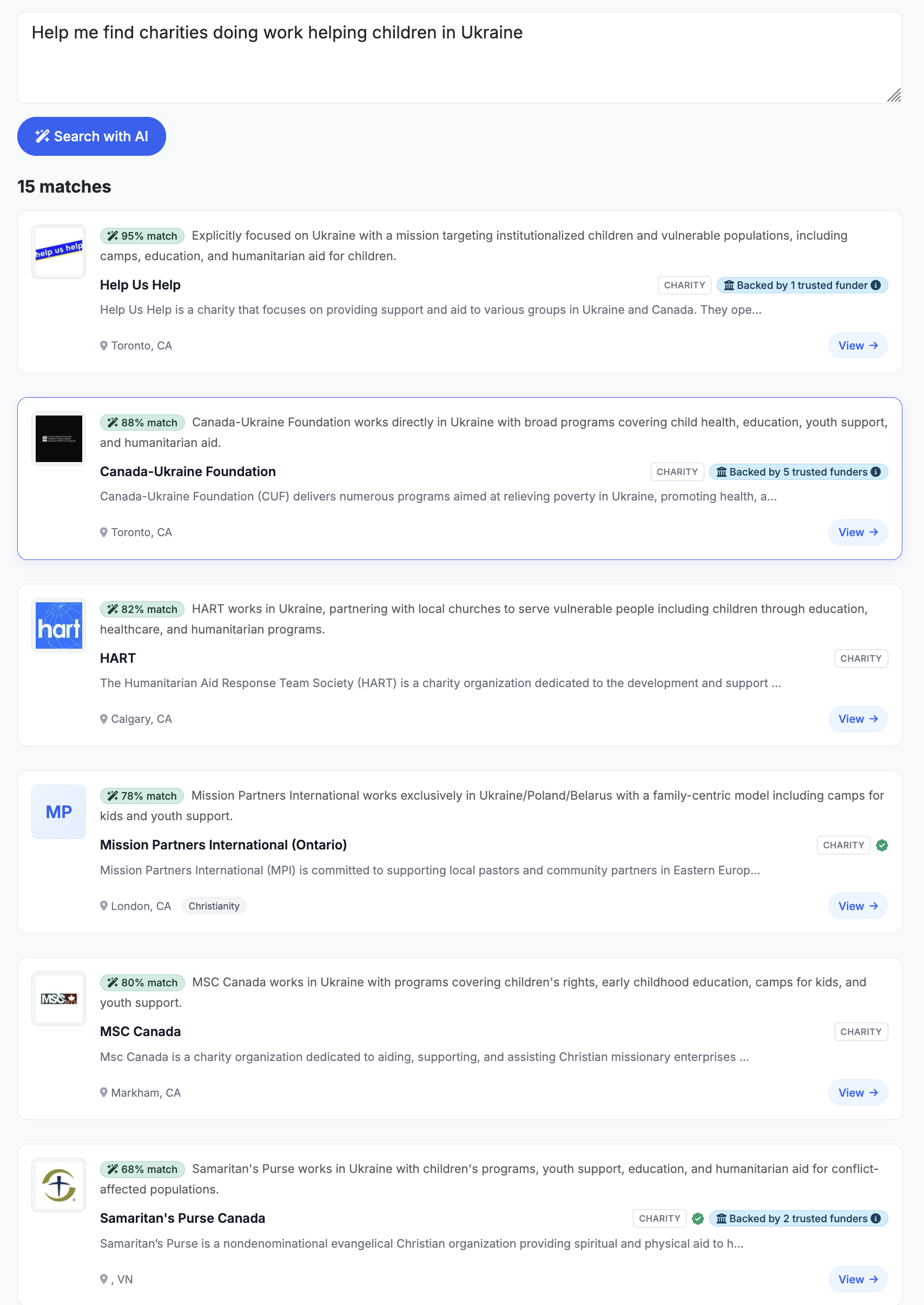
This is the part generic AI can't do. Ask ChatGPT for Canadian charity recommendations and you'll get plausible names you then have to verify one by one. Here, every result is a real, registered charity, and the diligence is one click away.
Some results carry an extra signal
Charities backed by one of a small group of rigorous Canadian funders carry a trusted funder mark. These funders run real diligence before they commit, so their backing carries information. It's one signal among several, it never changes rankings, and its absence says nothing against a charity. We've written openly about how we choose those funders, including how we built against the sector's bias toward big, well-connected names.
Then run a WellCheck
Due diligence in moments. A WellCheck pulls CRA filings, source documents, and peer benchmarks into one report covering governance, finances, and impact. Findings, not verdicts: you hand the client the facts, the family decides.

It works both directions. New charities the search surfaced, and the ones your client has been giving to for twenty years. That second one takes some care in the delivery, but clients almost always want to know.
So when a client asks about a charity you've never heard of, you have a real answer by the next meeting. That's what being the guide looks like.
Want to run a search and a WellCheck live? Twenty minutes. Book a time.
You've now seen the whole arc, one advisor at a time. What it looks like for a firm is the final part: everything your advisors need, already built.
Keep reading

Everything Your Advisors Need Is Already Built
The rollout kit for a firm's philanthropy practice already exists: branded client sheets, guided profiles, giving plans, search, and due diligence.

How to Initiate the Philanthropy Conversation [Part Three]
From Philanthropic Profile to Giving Plan: how advisors help clients plan giving by year, impact area, and pledge, and keep spending on track.

How to Initiate the Philanthropy Conversation [Part Two]
Your client said yes to the giving conversation. What wealth advisors do next: one question, a fifteen-minute conversation, a Philanthropic Profile.
Ready to modernize your philanthropy?
See how WellFunded can help your organization make better funding decisions.