A DAF is an impact machine. The question is who decides what it makes.
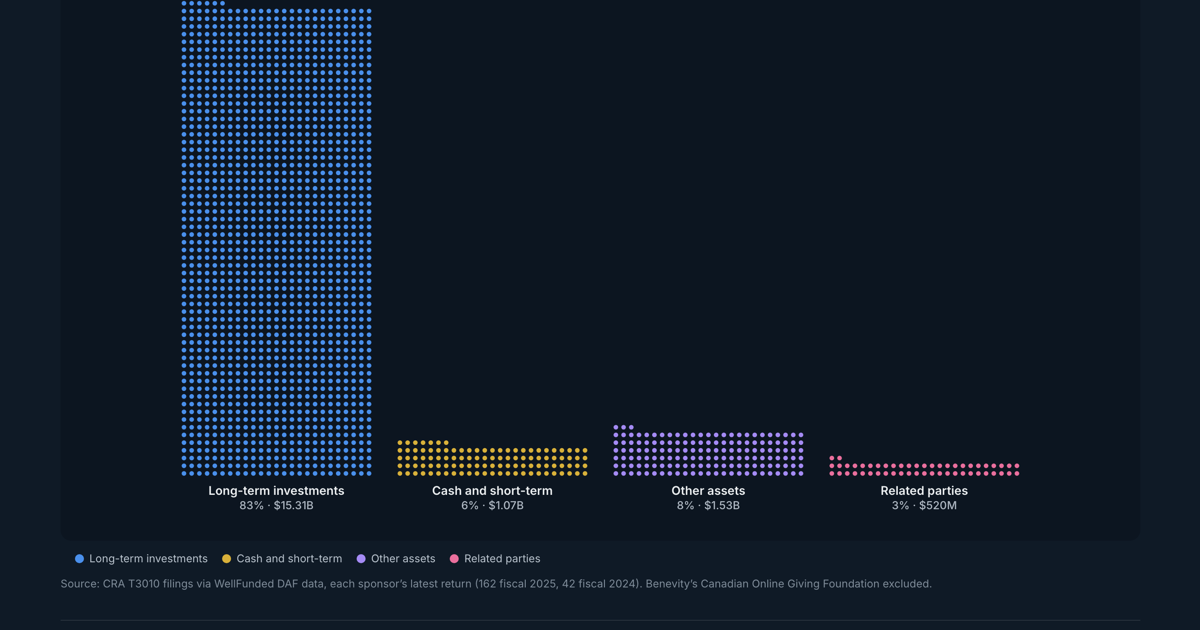
Canada's 204 DAF sponsors hold $18.5 billion. 83% is invested long term, about 2% is reported as impact investments, and the filings can't say what the rest is in. Here's what the T3010 shows about how DAF money is held, and the tools almost nobody is using yet.
Jeff Golby
CEO & Co-Founder, WellFunded
Key Takeaways
- Canada's 204 DAF sponsors hold $18.5 billion. 83% of it is invested for the long term, 6% is cash, and the T3010 can't say what it's invested in.
- Reported impact investments fell from just over $1 billion to $357 million, about 2% of DAF assets. Community foundations hold 20% of DAF dollars and 93% of those impact dollars.
- 13 sponsors took gifts of private company shares last year, five have every year since 2019, and none reports keeping a stake. The law has always let a DAF sponsor hold a gifted company or a building. The constraint is the business model.
Almost a decade ago, over sushi, a friend and I talked through how he could sell the majority stake in his private company one day, and that a DAF was uniquely suited to ensure charities and social impact organizations would receive incredible benefit, while minimizing his tax loss. It became a high nine-figure gift that still benefits charities around the world.
None of that shows up in an ESG report or a traditional impact fund. Neither does the investment that got WellFunded off the ground, part of which also came from a DAF. All of it creates impact. It's just not the kind we usually count.
This week I opened DAF Activated in Vancouver with new data on how Canada's DAF money is held, from the CRA filings of all 204 sponsors. My thesis was simple. A DAF is an impact machine. Every way it takes in, holds, moves and grants out money has an impact. The questions are what we count as impact, and who gets to decide. This is the short version, and the whole dataset is open to explore.
Explore how the $18.5 billion is held
The machine
Everything here comes from public CRA filings, the T3010. We looked at 204 sponsors, the charities reporting more than 10 DAF accounts. That strips out the churches and municipalities holding a handful of funds and leaves the organizations really in the business of running DAFs. Together they hold $18.5 billion across about 64,700 accounts, and Charitable Impact alone holds about one in five of those accounts. "DAF" is a huge term. It can be an online account with a few dollars in it or a bank account with tens of millions.
Roughly one in every four dollars given to charity in Canada now goes into a DAF first, and it doesn't just sit there. About one in four Canadian charities, 21,472 of them, received a DAF grant last year. The pool is growing faster than private foundation money, and it's not just market returns, because about 60% of last year's growth came from new gifts.
As for who holds it, ten sponsors hold 68% of all DAF money. A handful of organizations make most of the decisions about how it's held.
How the money is held
Turnover. Last year DAFs as a whole granted out about 11% of their assets, with plenty of variation inside that, while private foundations granted about 7.6%. This isn't a contest, and the legal minimum is 5%. The point is that DAF money moves, and new money is coming in even faster, so the pool keeps growing.
Cash. DAFs hold only about 6% of their assets in cash, roughly six and a half months of grants. Private foundations hold 24%. When interest rates rose in 2022, private foundations moved a lot into cash and GICs and mostly stayed there. DAF sponsors didn't move at all.
The invested portfolio. About 83% of DAF money sits in long-term investments, and two-thirds of what comes into DAFs arrives as non-cash gifts, mostly publicly traded shares. Cash is not king when it comes to DAFs. The limit is that the T3010 reports long-term investments as one line, with no split between stocks and bonds and nothing on fees or screening. Nearly all of the $18.5 billion is invested, and we can't see in what.
The other 95%
Let's look at one reason why aligning your grants and your investments might matter to you.
Last year 5.5% of DAF grant dollars went to environmental causes, about $122 million of $2.2 billion.
Now the other side of the ledger. About $15 billion of DAF assets sits in long-term investments, seven times what goes out in grants in a year. The T3010 doesn't say what's in it, but a typical Canadian equity index fund holds about 16% in energy, most of it oil and gas. If a DAF portfolio looks anything like the market, there is more DAF money invested in oil and gas than will ever reach an environmental charity.
I'm not here to shame that. Sponsors have a duty to earn a return, and they're working within real constraints. But holding an index fund is a decision, and so is holding cash. The $15 billion invested has an impact every day, one way or the other. Whether your DAF's assets are working against your grants is a fair question to ask whoever runs it.
The tools almost nobody is using
Where this gets most interesting is non-cash assets, because here the filings let us see more.
Real estate. Almost no DAF money is held in investment property. DAF sponsors report $163 million, and most of it sits at one college and a conservation group that hold DAFs alongside a much larger mission. Private foundations hold $1.6 billion in real estate, most of it buildings they use themselves, and $641 million of it in investment property.
Private company shares. Only 13 of 204 DAF sponsors took gifts of private company shares in 2024, and together they hold over half of all DAF money. But not one reports owning more than 2% of any company, while 63 private foundations do. The shares come in, and they get sold.
The law. None of this is a legal problem. Private company shares given to a DAF sponsor can be receipted right away, while the same shares given to the family's own private foundation get no receipt until they're sold. A public foundation can't buy control of a company, but gifted shares don't count toward the purchase test. Budget 2026 gave private foundations more room to hold company shares starting in 2027, and DAFs have had that room all along. The law allows some wonderful tax advantages for a DAF holding private company shares, and it seems DAFs have largely not used them. The constraint is the business model.
Who does what. By sponsor type, community foundations light up the impact investing column. Advisor and online platforms are the most likely to take private shares. And the last column, owning a meaningful stake in a company, is empty for every type.
I keep coming back to non-cash assets because DAFs have had this room all along. Patient control of a company, stewarding environmentally sensitive land and protecting a heritage building are all things a DAF could do to create positive impact while meeting its fiduciary duty, before we even get to reported impact investing.
A DAF that held the local employer, or the building a charity works out of, or a piece of environmentally sensitive land, would be generating returns for a community for decades, not a cheque a year.
Reported impact investments
Two years ago the CRA added a line to the T3010 for impact investments: "investments in companies or projects made with the intention of having a measurable positive environmental or social impact." I call these reported impact investments, because that's what they are: what the form asks charities to count. By that definition, a lot of what we just walked through could count too. Today it wouldn't show up in the box.
On their latest returns, 27 of the 204 sponsors report any. The total is $357 million, about 2% of DAF assets. For comparison, 0.4% of other public foundations and 0.2% of private foundations report any at all.
Community foundations lead by a wide margin. They hold 20% of DAF dollars but 93% of reported impact investments. Battle River Community Foundation and the Community Foundation of Greater Peterborough report more than two-thirds of their assets this way, Toronto Foundation runs a dedicated social impact investment fund, and Vancouver Foundation anchored Spring Impact Capital. They started this, and they're further along than anyone.
Then there's the swing. Reported impact investing by DAF sponsors fell from just over $1 billion to $357 million in the latest year. About half of that drop is one organization, and almost all of the rest is a handful of others. Some of it is reporting changes, and some of it is assets moving out. Everyone else's reported impact investing grew about 12%, so we'll see what the next two years bring.
Who decides
Legally, the sponsor. It owns the assets and sets the investment policy, and the donor advises. Sponsors have more room than most people realize.
I said at the start that a DAF is an impact machine. The real questions are who defines impact, how we create it, and who's in the room when those conversations happen.
I've benefited from the impact DAFs create, and I've seen countless others benefit too. It was that sushi conversation, so long ago, that showed me how often we work with one hand tied behind our back. But I'm optimistic about conversations like this, about the data we've shared, and about the future of good that can come when we bring every tool we have to the biggest problems facing the planet. The data behind all of this is open: every sponsor, how the money sits, who takes private shares, who reports impact investments, and who holds property.
Short answers on this topic
Keep reading
We traced every DAF grant in Canada. Here's where the money goes.
Canada's donor-advised funds grant $2.2 billion a year. We mapped every grant from the CRA filings and made it free to explore. A few of the numbers stopped me.
How Charitable Dollars Actually Reach Charities
Canada's payment infrastructure moves $411B daily. Charitable disbursements still rely on void cheques and manual batch files.
What the DAF data means for you: eight findings, three ways to read them
We mapped every grant Canada's DAF sponsors reported to the CRA. This field guide turns eight findings into practical advice for charities, advisors and DAF programs.
Ready to modernize your philanthropy?
See how WellFunded can help your organization make better funding decisions.