How Charities Get DAF Grants in Canada
Most DAF grants aren't unsolicited. Here's what actually happens before the cheque arrives, and how Canadian charities can get found by donor-advised funds instead of surprised by them.

Jeff Golby
CEO & Co-Founder, WellFunded
The short answer
Most DAF grants that land on a charity's desk feel unsolicited. They rarely are. Here's what actually happens before the cheque arrives, and how charities can be part of that process instead of surprised by it.

Key Takeaways
- A DAF grant is rarely random. Most trace back to an advisor conversation and due diligence run before the cheque was ever written
- 30% of Canadian charities report no knowledge of donor-advised funds, yet more than half received a DAF gift in the past year, according to the 2026 Growing Together report
- Charities can improve their odds by claiming a free profile, making due diligence easier to find, and understanding how verified disbursement protects both sides of the relationship
A cheque arrives from a foundation nobody on staff recognizes. Someone asks who they are. Often, nobody knows.
That scenario is common enough that it recently sparked a public conversation among Canadian nonprofit leaders, after Angie Gélinas, President and CEO of the Nonprofit Chamber, described exactly this moment and asked a good question: is a DAF grant really unsolicited?
Mostly, no. Behind the cheque is usually an advisor conversation, a family's giving framework, and due diligence someone ran on the organization months earlier. The cheque is the last visible step of a process the charity was never in the room for.
The Knowledge Gap Runs Both Ways
New Canadian research backs this up. Growing Together, a 2026 report by Dr. Sharilyn Hale and Keith Sjögren of Watermark Philanthropic Counsel, surveyed about 1,000 registered charities through the Charity Insights Canada Project at Carleton University. Thirty percent said they had no knowledge of donor-advised funds at all. More than half had received a DAF gift in the past year regardless.
The researchers also found the gap runs in both directions. DAF foundations often understand charity funding structures about as poorly as charities understand DAFs. Canada's DAF landscape has grown to roughly $17.3 billion in assets, according to WellFunded's own DAF Data, the fastest-growing giving vehicle in the country is, in practice, connecting two groups of relative strangers.
What Actually Happens Before the Cheque Arrives
When a fund holder considers a gift, an advisor often raises the idea first, as part of a broader giving conversation rather than a single transaction. From there, the fund holder or their advisor typically look into the charity: what it does, whether it's in good standing with the CRA, and whether a due diligence report exists that speaks to its governance and finances.
This is where advisor relationships matter more than most charities give them credit for. Running a small charity for a decade, my own approach was to spend as much time on advisor relationships as on donor relationships directly. Advisors are usually already in the room when a giving decision gets made. A charity that's invisible to them is starting the conversation late, if it gets to have one at all.
The Cheque Itself Isn't Always Straightforward Either
Charities have their own version of the mystery cheque problem, just in reverse. A DAF administrator asks for banking details, and it's not always obvious whether the request is legitimate. Meanwhile, DAF administrators have historically relied on void cheques as proof that a bank account belongs to the charity, something that's easy to forge and doesn't actually prove ownership.
WellPay is what we're building to close that gap from both sides. The idea: a charity submits its banking details once, confirmed through Instant Bank Verification and matched to its CRA-registered name, and every DAF in the network sees the same verified information going forward. No re-entering details for every new funder, no DAF left trusting a piece of paper.
A group of Canadian DAFs are already shaping WellPay with us as founding partners. It's part of what we're building with DAFs and charities together, not just for one side of the relationship.
How Charities Can Get Found and Get Funded
A few things are within a charity's control here:
Claim a free profile. WellFunded maintains a basic profile for every registered Canadian charity, built from CRA data. Claiming it lets a charity add its story, photos, and impact metrics, the details a generic CRA filing can't capture.
Understand what a due diligence report actually says about you. A WellCheck report draws on CRA filings, audited financials, and public records, along with a short set of questions charities can answer directly to add context. It's not a score or a rating. It's the kind of information an advisor or fund holder is likely already looking at before they decide to give.
Watch for verified banking infrastructure. WellPay, currently in development with founding DAF partners, will let charities verify their banking details once and have that verification recognized across every DAF on the network, instead of proving ownership over and over to each new funder.
None of this replaces relationship-building or direct fundraising. It just means that when someone is looking a charity up, whether that's an advisor, a fund holder, or a DAF administrator, there's something accurate and current to find.
Ready to be found by the DAF grants already looking for organizations like yours? Claim your free charity profile.
Frequently Asked Questions
How do most charities actually receive DAF grants in Canada?
Most DAF grants follow an advisor conversation and a period of due diligence that happens before the charity is ever contacted. The gift itself is usually the final step of a process, not a first outreach.
Why don't more charities know about donor-advised funds?
DAFs have grown quickly in Canada, from $5.4 billion in assets in 2019 to $16.6 billion by 2024, but there's been little shared infrastructure or education connecting charities to how the sector actually works. The 2026 Growing Together report found this knowledge gap runs in both directions, charities and DAF foundations understand each other's world imperfectly.
How can a charity make itself easier to find for DAF grants?
Claiming a free charity profile, keeping CRA details current, and understanding what a due diligence report shows about the organization all make a charity more discoverable and more fundable, without changing how it fundraises directly.
Why do charities need to verify their banking details with DAF providers?
Historically, DAF administrators have relied on void cheques to confirm banking details, which don't actually prove account ownership. WellFunded is building WellPay with founding DAF partners to let charities verify their banking details once and have that recognized across the network, protecting charities from delayed or misdirected payments and protecting DAFs from sending funds to an unverified account.
Keep reading
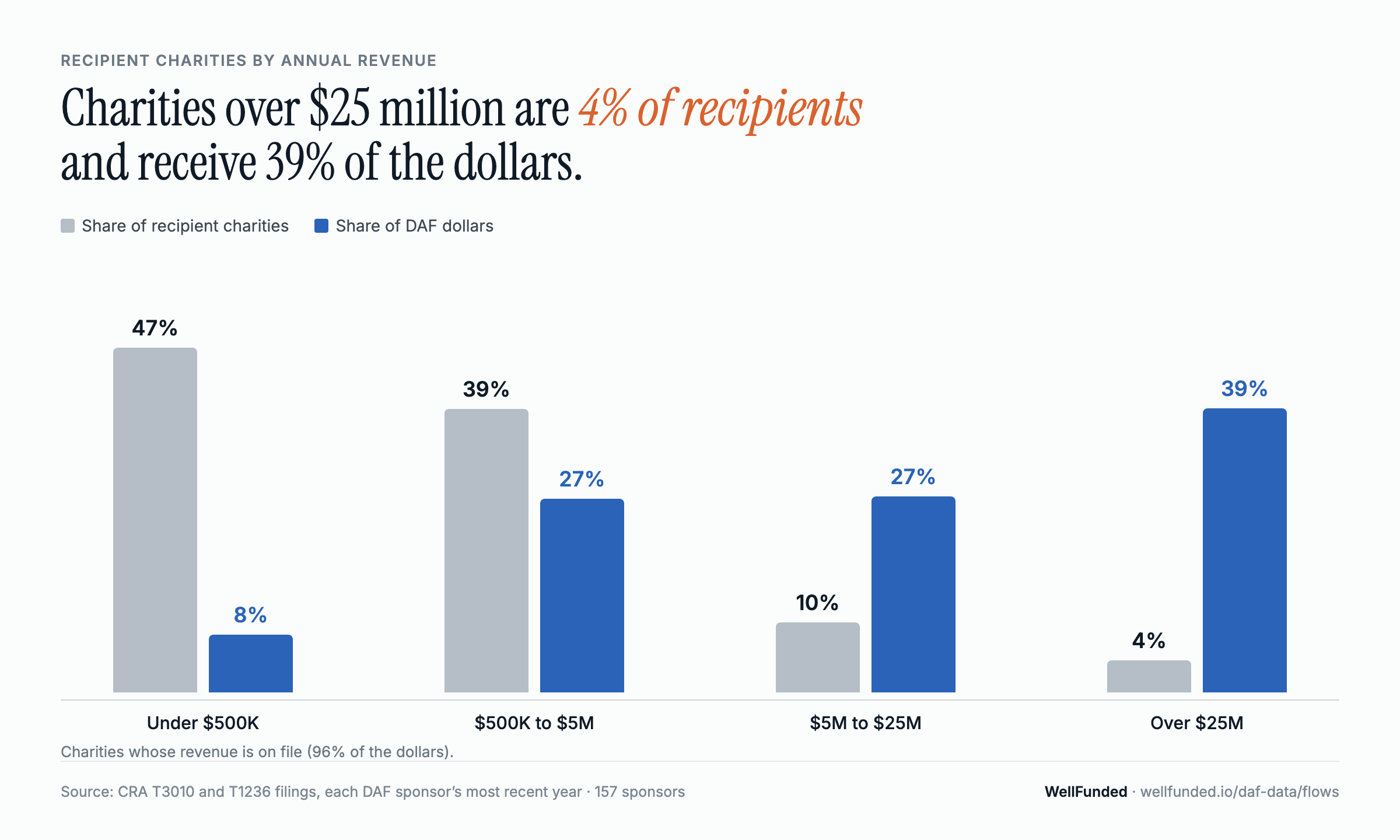
What the DAF data means for you: eight findings, three ways to read them
We mapped every grant Canada's DAF sponsors reported to the CRA. This field guide turns eight findings into practical advice for charities, advisors and DAF programs.

We traced every DAF grant in Canada. Here's where the money goes.
Canada's donor-advised funds grant $2.2 billion a year. We mapped every grant from the CRA filings and made it free to explore. A few of the numbers stopped me.
Missed Connections
Charities told us what actually happens after a donor-advised fund gift lands. Missing contact details, guesswork on anonymous, duplicated work, and a system running on 1998 infrastructure.
Claim your free charity profile
One profile connects you to Canada's largest DAF network. It takes about ten minutes, and it's free for charities.