Finding the Signal: Smart Search and Recommendations
How WellFunded's new natural language search helps advisors cut through 86,000 charities to find the right one, and stand behind it.

Jeff Golby
CEO & Co-Founder, WellFunded

Key Takeaways
- Search now reads donor intent in plain language and ranks charities on one thing: how well they match what you asked for.
- Recommendations surface when a charity is backed by Canada's most rigorous funders, a trust signal you can act on, never a ranking input.
- Intent decides who you see. Trust signals help you decide who to recommend. We keep those two questions separate on purpose.
A few months ago, on a live training session, an advisor asked me a question I couldn't answer well.
"How would I find organizations helping children affected by the war in Ukraine?"
Our search was good. The best in Canada, I'd happily argue. But it struggled to get underneath the impact categories, even the ones we had built ourselves. The advisor knew exactly what their client cared about. Our tools made them guess at which category might contain it.
That gap is the real problem in front of every advisor. There are more than 86,000 registered charities in Canada. When you recommend one to a client, you are staking your credibility on it. The old way of searching forced a choice between over-researching every name or recommending narrowly and cautiously. Either way, the cost was not inconvenience. It was risk.
This month we shipped two things that close that gap. Here is how they work, and just as importantly, how they don't.
Search reads what you mean
Natural language search lets you describe what your client cares about in plain language, and the noise of the sector resolves into a shortlist that fits.
No more guessing which impact area applies. No more deciding whether it's "Lower Mainland" or Vancouver proper. You type what comes to mind, and you get a clean, intelligent response.
- Mental health support for teens in Halifax
- Kitten rescue in Comox under $2 million
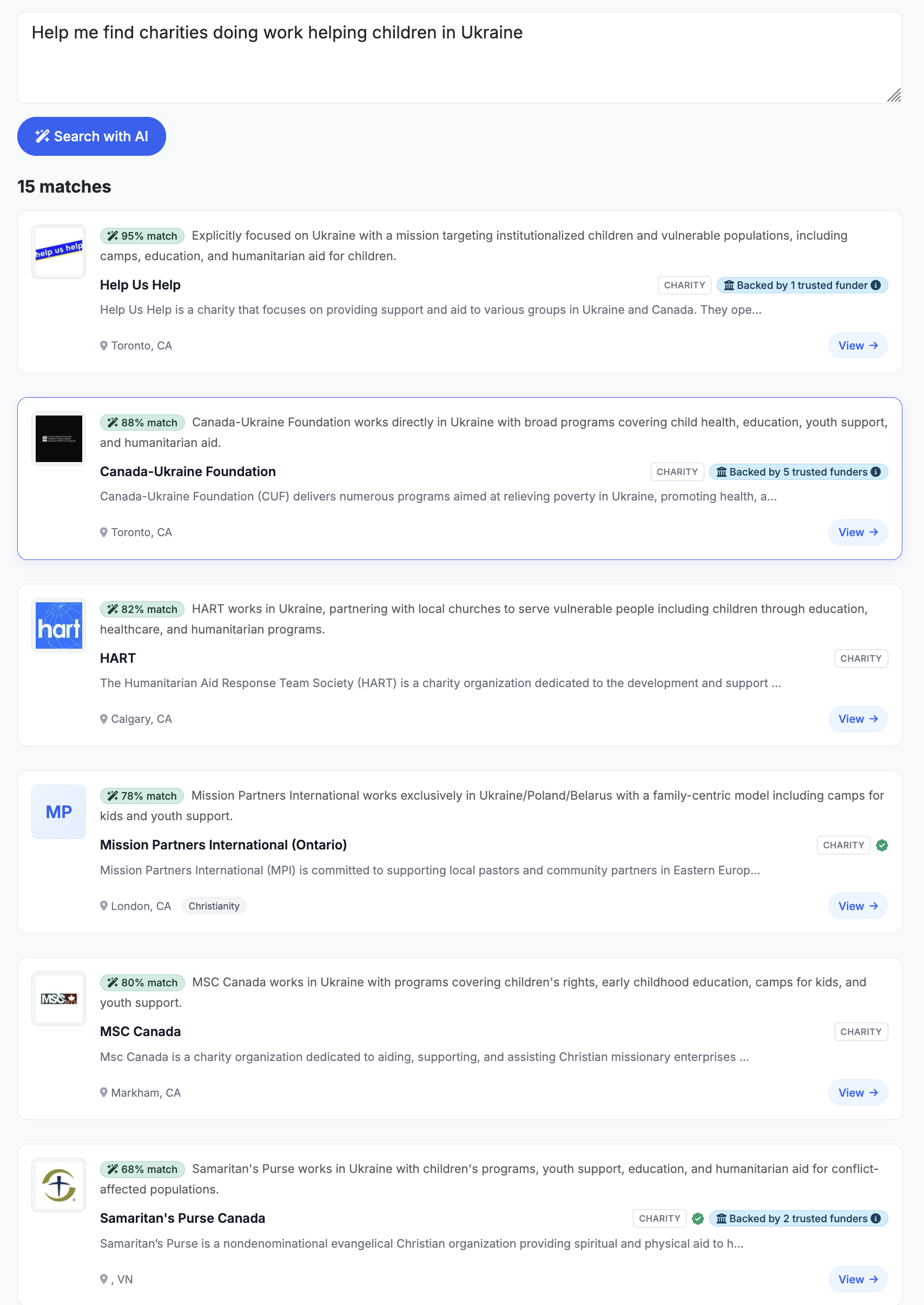
- Organizations helping children affected by the war in Ukraine
Here is the part that matters most. Search ranks on one thing only: how well a charity matches what you asked for. Not who is biggest. Not who has the largest budget. Not who paid, because no one can. Your client's intent decides the order, full stop.
Finding them is half the job
The other half is being able to stand behind the name. So we answer two questions, not one. Who fits what my client cares about, and who can I trust.
The first question is the search. The second is where Recommendations come in.
Recommendations: the signal in the noise
When a charity is backed by one of a small group of Canada's most rigorous funders, you now see it right in your results.
That signal does real work. It is the confidence to recommend a charity to a client, or the prompt to request a WellCheck and go deeper before you do. It is the difference between a name you found and a name you can stand behind.
These funders are chosen for the rigour of their process, and because they fund small charities as well as large ones, so the signal points toward diligence rather than size. We explain exactly how we choose trusted funders in a separate piece, because it deserves its own.
What the signal is not is a ranking input. It never changes where a charity lands in your results.
Why we keep them separate
This is the deliberate part, and it is the whole philosophy in one idea.
A charity backed by no large funder can sit at the top of your results on the strength of the match alone, and often does. In a recent search for mental health organizations serving all of Canada, the second-ranked result carried no funder badge at all. It ranked second because it was the second-best match. The badges on the charities below it did not move them up, and its lack of one did not move it down.
In the product: the match score sorts the list. The trust signals ride alongside the position a charity has already earned. One axis ranks. The other informs. They never cross.
We built it this way on purpose. Most discovery tools quietly let something other than fit shape the order, who is biggest, who is connected, sometimes who paid, and the person searching never knows the list was sorted by something other than what they asked for. We refused that. Intent is the only thing allowed to rank. Trust is only ever allowed to inform.
And placement, just like ranking, can never be bought or gamed. The trust signal comes from public funder data. A charity cannot fake whether a rigorous funder backed it.
What this means for the work
For advisors, this is the part that changes the day to day. You describe what your client cares about, and the sector's noise becomes a ranked shortlist that fits. Then, on the names that matter, you see who else already trusts them, so you can recommend with confidence or dig deeper with a WellCheck.
The same intelligence powers WellAdvised. A client's Philanthropic Profile becomes a shortlist matched to their values, with the trust signals already in view.
Intent decides who you see. Trust helps you decide who to recommend. You find the signal, and you can stand behind it.
Keep reading

Introducing WellCheck v2.1: Due Diligence, Reimagined
WellCheck v2.1 delivers comprehensive charity due diligence powered by AI — analyzing source documents, CRA filings, and peer benchmarks in minutes.
How a Philanthropic Profile Gets Built
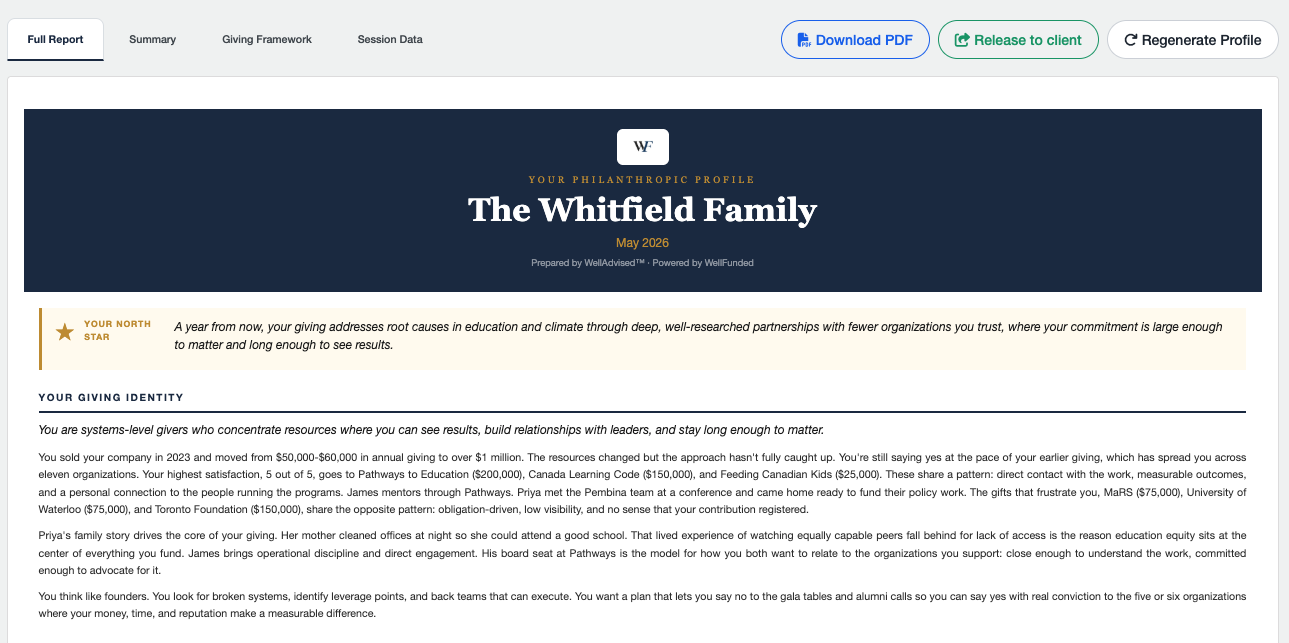
A guided walkthrough of the WellAdvised conversation. How a Philanthropic Profile gets built, from intake to AI synthesis, in 15-20 minutes.

Introducing WellAdvised: From Small Talk to Strategy
WellAdvised is an AI-powered philanthropic planning tool that helps advisors turn values conversations into professional, shareable Philanthropic Profiles.
Try it in WellFunded
Log in to see this in your account, or visit the help centre for step-by-step walkthroughs.