Introducing WellCheck v2.1: Due Diligence, Reimagined
WellCheck v2.1 delivers comprehensive charity due diligence powered by AI — analyzing source documents, CRA filings, and peer benchmarks in minutes.

Jeff Golby
CEO & Co-Founder, WellFunded

Key Takeaways
- WellCheck v2.1 analyzes source documents like theories of change, audited financials, and annual reports — not just questionnaire answers
- Fewer questions for charities, deeper analysis for donors — powered by WellFunded's AI-driven analysis engine
- Now available in fully branded, PDF-printable versions with peer benchmarking across 85,000+ Canadian charities
We launched the first version of WellCheck in spring 2025. We've iterated on it several times since then, and today we're pleased to share our most comprehensive version to date.
WellCheck v2.1 is a complete reimagining of charity due diligence at scale.
What Changed — and Why
The original WellCheck asked charities a series of questions, cross-referenced their answers against CRA filings, and generated an assessment. It worked. But we knew we could go deeper.
The tension we've been solving from day one is this: donors need thorough due diligence, and charities need to not become another administrative burden. Those two things usually conflict. A foundation conducting proper due diligence might spend dozens of hours and thousands of dollars per assessment. A charity fielding those requests from multiple funders is repeating the same work over and over.
WellCheck v2.1 resolves that tension in a way that wasn't possible even a year ago.
How It Works Now
Powered by our AI-driven analysis engine — built on the most intelligent large language model available — WellCheck v2.1 dramatically reduces the number of questions we ask charities while significantly deepening the analysis. Instead of relying primarily on questionnaire responses, WellCheck now reads and reasons through source documentation — the same materials a skilled grants officer would review.
That means analyzing:
- Theory of change — Is there a coherent causal pathway from programs to outcomes? Are assumptions stated? Are risks acknowledged?
- Audited financial statements — Not just ratios, but context. What does the auditor's opinion say? Are there related-party transactions or economic dependence disclosures?
- Annual reports — What claims is the organization making about its impact, and what evidence supports those claims? Are outputs being presented as outcomes?
- Years of CRA T3010 filings — Revenue trends, program spending ratios, staffing, board composition, received gifts from other charities, and more
- Peer benchmarking — How does this charity's financial profile compare to similar organizations in the same impact area and revenue category?
Each dimension — governance, financial health, impact, leadership, communications, and accreditations — is analyzed independently, then synthesized into a cohesive assessment. The analysis engine doesn't just pattern-match for keywords. It reasons through the data the way an experienced analyst would, understanding context, tracking trends, and distinguishing between a one-time anomaly and a systemic concern.
What We Removed
Scoring. We never wanted to be in the ratings game. Reducing a complex organization to a single number creates more controversy than clarity, and it misses the point of due diligence entirely. Good grantmaking isn't about finding charities that score above a threshold — it's about understanding whether an organization is a strong fit for your philanthropic goals.
What We Added
Peer benchmarking gives donors context they've never had before. You can now see how any charity's financial profile compares against hundreds of similar organizations — same impact area, same revenue bracket. Not "good" or "bad." Just context.
Source document analysis means WellCheck no longer depends solely on what a charity tells us. It reads the documents themselves — the same ones a professional grants officer would request — and surfaces findings that questionnaire answers alone could never capture. Things like whether a theory of change actually traces a plausible pathway to impact, or whether an annual report's claims are backed by quantitative evidence or anecdotal testimonials.
Impact reporting tables break down an organization's claims by type (output, outcome, impact) and evidence quality (quantitative, qualitative, anecdotal). This helps donors quickly understand the difference between what a charity has measured and what it's hoping for.
Trust, But Verify
This is perhaps the most important thing to understand about WellCheck: it is not a watchdog.
WellCheck is your guided tool for trusting — and verifying — the incredible charities working every day to make this world better. The analysis engine is designed to default to charitable interpretation when multiple explanations exist, to avoid evaluative language like "red flag" or "crisis," and to present factual findings that allow donors to draw their own conclusions.
When WellCheck surfaces a gap — say, a board that meets less frequently than typical benchmarks — it doesn't sound an alarm. It provides context, explains why the gap matters, and suggests what a donor might want to ask. That's the difference between a rating system and a due diligence tool.
Branded, Printable, Shareable
WellCheck reports are now available in fully branded versions — your logo, your colors, your look and feel. They're PDF-printable, professionally formatted, and designed to be shared with boards, investment committees, and fund holders.
For DAF providers and foundations, this means you can offer your clients professional-grade due diligence under your own brand, without building the infrastructure yourself.
For Charities: Upgrading Is Fast
If your organization completed a WellCheck under a previous version, upgrading is quick. Your previous answers are pre-filled, and the new version requires just a few additional document uploads and two new questions.
Learn how to update your WellCheck to v2.1 →
One Report. Every Use Case.
Whether you're a DAF provider supporting fund holders who want to give with confidence, a wealth advisor conducting charity vetting as part of your client's philanthropic plan, a corporation running a CSR granting program and needing to demonstrate responsible grantmaking, or meeting your organization's compliance and anti-money laundering due diligence requirements — WellCheck delivers the same rigorous, standardized assessment.
That's the point. Due diligence shouldn't look different depending on who's asking. A corporate giving program evaluating a potential grant recipient deserves the same depth of analysis as a private foundation or a family with a donor-advised fund. WellCheck makes that possible without building separate processes for each.
What This Means for the Sector
This kind of in-depth analysis would normally take dozens of hours and cost thousands of dollars. It's now available in minutes on WellFunded — for every user, across every charity in our system.
Canadian philanthropy has lacked standardized, scalable due diligence infrastructure. Donors have had to choose between superficial ratings and expensive consultants. Charities have had to choose between ignoring due diligence requests and drowning in them.
WellCheck v2.1 is our answer to that problem. Thoughtful, detailed, and built to respect both the donors asking the questions and the charities doing the work.
Want to see WellCheck in action? Explore a sample report or contact us to learn more about branded WellCheck reports for your organization.
Keep reading

Introducing WellAdvised: From Small Talk to Strategy
WellAdvised is an AI-powered philanthropic planning tool that helps advisors turn values conversations into professional, shareable Philanthropic Profiles.

Finding the Signal: Smart Search and Recommendations
How WellFunded's new natural language search helps advisors cut through 86,000 charities to find the right one, and stand behind it.
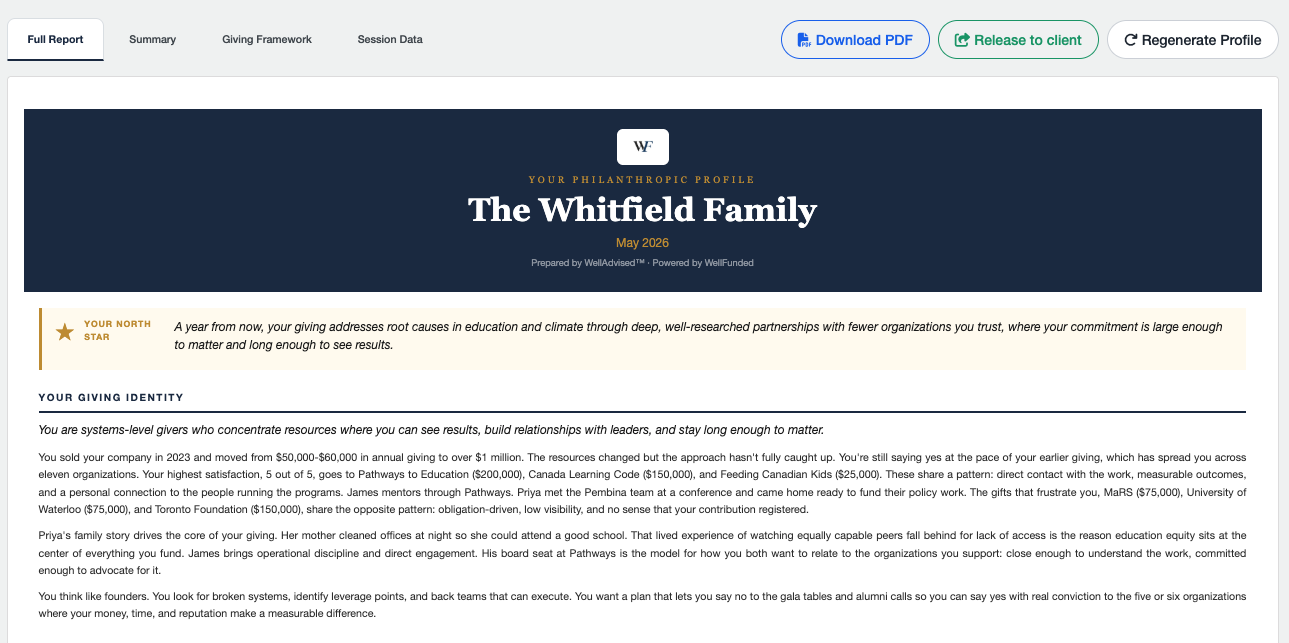
How a Philanthropic Profile Gets Built
A guided walkthrough of the WellAdvised conversation. How a Philanthropic Profile gets built, from intake to AI synthesis, in 15-20 minutes.
Try it in WellFunded
Log in to see this in your account, or visit the help centre for step-by-step walkthroughs.